
Copyright:Ralf Vandebergh
中文翻譯:
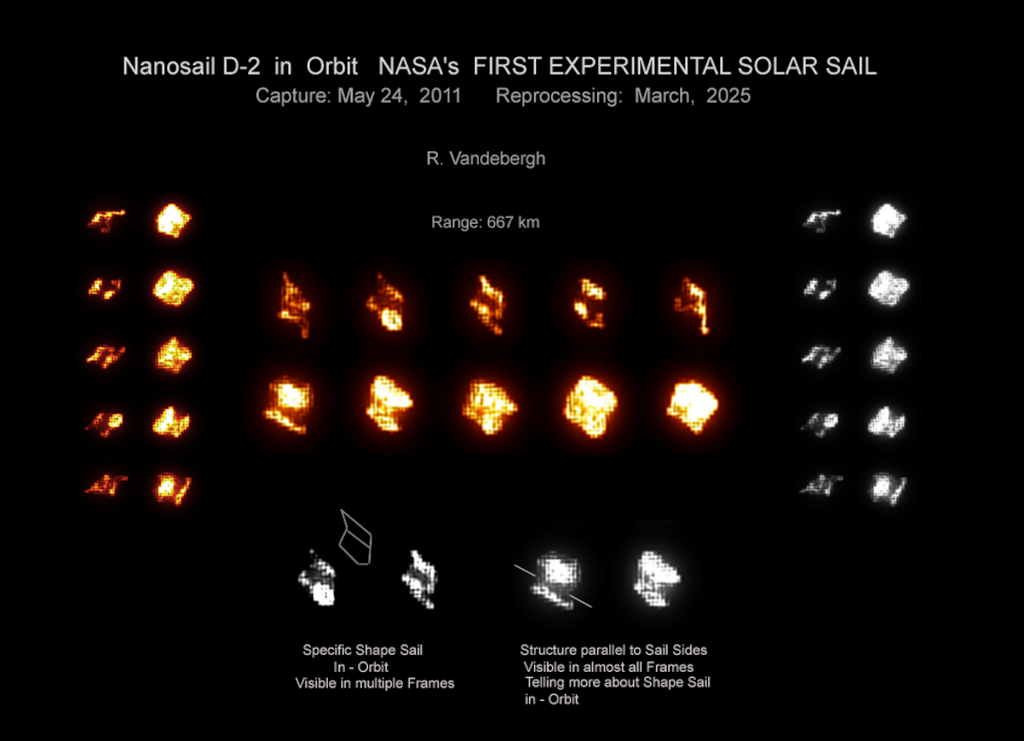
在2011年1月20日,NASA的NanoSail-D2展開了一片非常薄且非常反光的太陽帆,成為第一個在低地球軌道中航行的太陽帆太空船。這個想法可以追溯到400年前,當時天文學家約翰內斯·開普勒觀察到彗星尾部被太陽風吹拂的情景。像NanoSail-D2、日本的星際太空船IKAROS或行星協會的Lightsail A等現代太陽帆太空船設計,依賴的是來自陽光的微小但持續的推力。當NanoSail-D2環繞地球時,它的太陽帆在陽光下閃閃發光,讓人眼前一亮。這些令人驚嘆的細緻影像是通過用小望遠鏡手動追蹤這艘軌道上飄動的太陽帆太空船獲得的。
原文:
In 2011, on January 20, NASA’s NanoSail-D2 unfurled a very thin and very reflective 10 square meter sail becoming the first solar sail spacecraft in low Earth orbit. Often considered the stuff of science fiction, sailing through space was suggested 400 years ago by astronomer Johannes Kepler, who had observed comet tails blown by the solar wind. But modern solar sail spacecraft designs, like NanoSail-D2, Japan’s interplanetary spacecraft IKAROS, or the Planetary Society’s Lightsail A, rely on the small but continuous pressure from sunlight itself for thrust. Glinting in the sunlight as it circled planet Earth, NanoSail-D2’s solar sail was periodically bright and visible to the eye. These remarkably detailed images were captured by manually tracking the orbiting solar sail spacecraft with a small telescope.
來源:NASA每日圖片

