
Copyright:Michal Wierzbinski
中文翻譯:
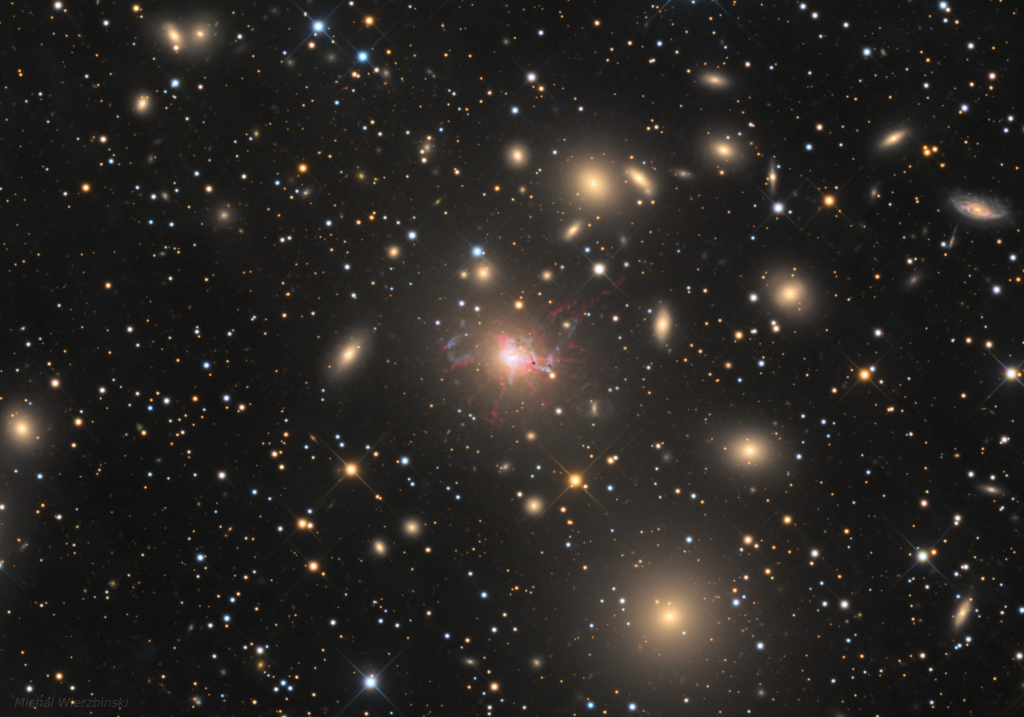
在遙遠的宇宙中,有一個叫做NGC 1275的活躍星系,這個星系是一個名叫「英仙座星團」的大家族中的重要成員。這個星系長得非常特別,當我們用望遠鏡觀察它時,能看到它發出光彩的氣體和奇特的形狀。NGC 1275不僅在可見的光波長中很吸引人,還是X射線和無線電波的強大來源。它像一個巨大的吸塵器,能吸引周圍的星系,並將這些星系的物質吸入自己的中心,最終供養著一個龐大的黑洞。科學家們用特別的影像資料,捕捉到了在這個星系中漂浮著的星際塵埃和發光的氣體絲,這些絲的長度可達到20,000光年!這些氣體絲在NGC 1275中持續存在,即使周圍的碰撞可能會將它們摧毀。那麼,是什麼讓這些氣體絲能夠保持在一起呢?觀察顯示,這些由黑洞活動推送出來的結構是由磁場牢牢地吸引在一起的。NGC 1275的直徑超過100,000光年,距離地球約230百萬光年。這個星系也被叫做「Perseus A」。
原文:
Active galaxy NGC 1275 is the central, dominant member of the large and relatively nearby Perseus Cluster of Galaxies. Wild-looking at visible wavelengths, the active galaxy is also a prodigious source of x-rays and radio emission. NGC 1275 accretes matter as entire galaxies fall into it, ultimately feeding a supermassive black hole at the galaxy’s core. Narrowband image data used in this sharp telescopic image highlights the resulting galactic debris and filaments of glowing gas, some up to 20,000 light-years long. The filaments persist in NGC 1275, even though the turmoil of galactic collisions should destroy them. What keeps the filaments together? Observations indicate that the structures, pushed out from the galaxy’s center by the black hole’s activity, are held together by magnetic fields. Also known as Perseus A, NGC 1275 itself spans over 100,000 light years and lies about 230 million light years away.
來源:NASA每日圖片

