
中文翻譯:
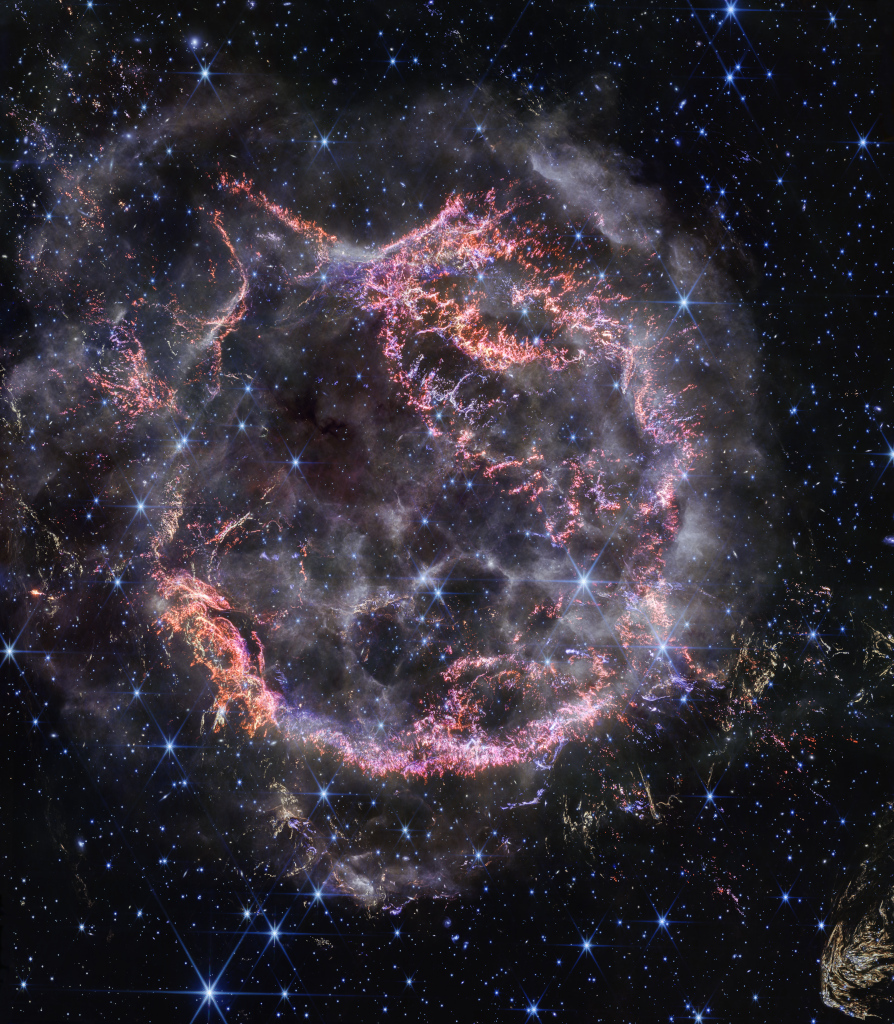
在我們的銀河系中,巨大的恆星們過著壯觀的生活。它們從遙遠的宇宙雲朵中壓縮而來,然後點燃其核反應爐,並在內部創造出重元素。對於最巨大的恆星來說,這一切只需幾百萬年,然後它們所產生的那些豐富物質會被炸回到星際空間,讓新的恆星形成。名為Cassiopeia A的擴展雲雖然消亡,但它也展示了恆星生命週期的最後階段。創造這個遺骸的超新星爆炸在大約350年前首次被地球上的人們看到,然而那道光芒卻花了11,000年才到達我們。這幅來自James Webb太空望遠鏡的清晰NIRCam圖像展示了在超新星殘骸中,仍然熱乎乎的絲狀物和結。擴張的爆炸波外殼呈煙霧狀,寬約20光年。在Webb對周圍星際介質的詳細圖像中,也能識別出來自這顆巨星災變性爆炸的光回響。
原文:
Massive stars in our Milky Way Galaxy live spectacular lives. Collapsing from vast cosmic clouds, their nuclear furnaces ignite and create heavy elements in their cores. After only a few million years for the most massive stars, the enriched material is blasted back into interstellar space where star formation can begin anew. The expanding debris cloud known as Cassiopeia A is an example of this final phase of the stellar life cycle. Light from the supernova explosion that created this remnant would have been first seen in planet Earth’s sky about 350 years ago, although it took that light 11,000 years to reach us. This sharp NIRCam image from the James Webb Space Telescope shows the still-hot filaments and knots in the supernova remnant. The whitish, smoke-like outer shell of the expanding blast wave is about 20 light-years across. A series of light echoes from the massive star’s cataclysmic explosion are also identified in Webb’s detailed images of the surrounding interstellar medium.
來源:NASA每日圖片

