
Copyright:Olaf Filzinger
中文翻譯:
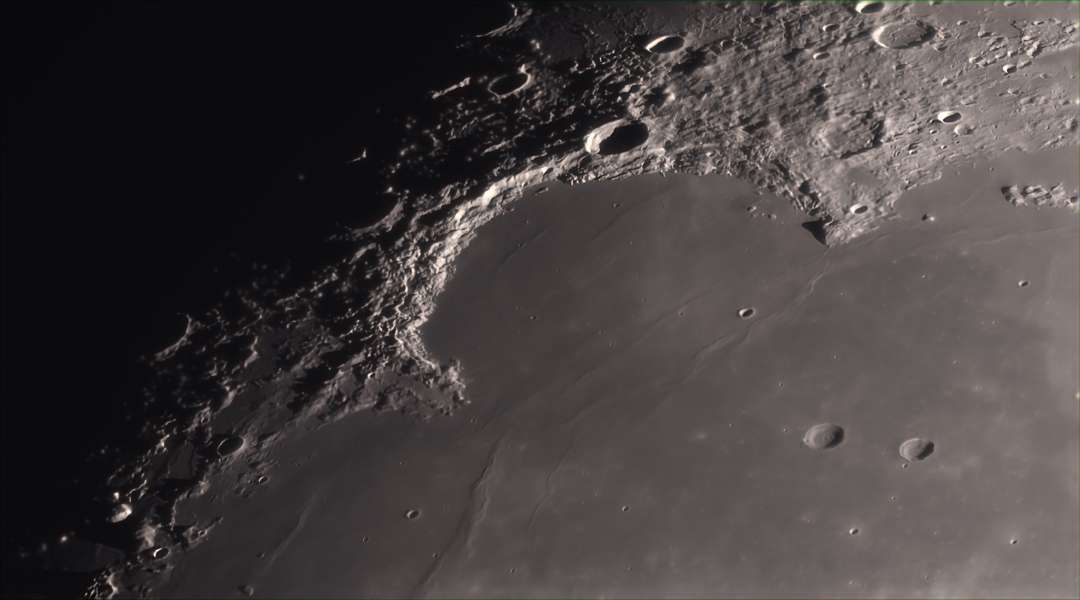
你知道月亮上有很平滑、黑黒的地方嗎?這些區域被稱為“海洋”和“海”的名字,雖然它們看起來不像真正的水域。其實這些地方是被熔岩填滿的隕石撞擊盆地!比如說,這裡有一片叫做Mare Imbrium的地方,意思是「雨之海」。再往裡看,還有一個名叫Sinus Iridum的灣,這個灣叫做「彩虹灣」。周圍有高高的Jura Mountains,這些山約有250公里寬!當陽光升起後,這些山在灣的邊邊形成了一道美麗的弧形。這些山的最高點叫做Cape Laplace,幾乎有3,000米高,與灣面的距離差不多。而在弧形的底部是Cape Heraclides,這個地方在1679年的時候被一位叫Giovanni Cassini的天文學家畫過,畫裡的月亮像個擁有長長頭髮的女孩。
原文:
Dark, smooth regions that cover the Moon’s familiar face are called by Latin names for oceans and seas. That naming convention is historical, though it may seem a little ironic to denizens of the space age who recognize the Moon as a mostly dry and airless world, and the smooth, dark areas as lava-flooded impact basins. For example, this telescopic lunar vista, looks over the expanse of the northwestern Mare Imbrium, or Sea of Rains and into the Sinus Iridum, the Bay of Rainbows. Ringed by the Jura Mountains (montes), the bay is about 250 kilometers across. Seen after local sunrise, the mountains form part of the Sinus Iridum impact crater wall. Their rugged sunlit arc is bounded at the top by Cape (promontorium) Laplace reaching nearly 3,000 meters above the bay’s surface. At the bottom of the arc is Cape Heraclides, depicted by Giovanni Cassini in his 1679 telescope-based drawings mapping the moon as a moon maiden seen in profile with long, flowing hair.
來源:NASA每日圖片


