
Copyright:Juan Carlos Casado
中文翻譯:
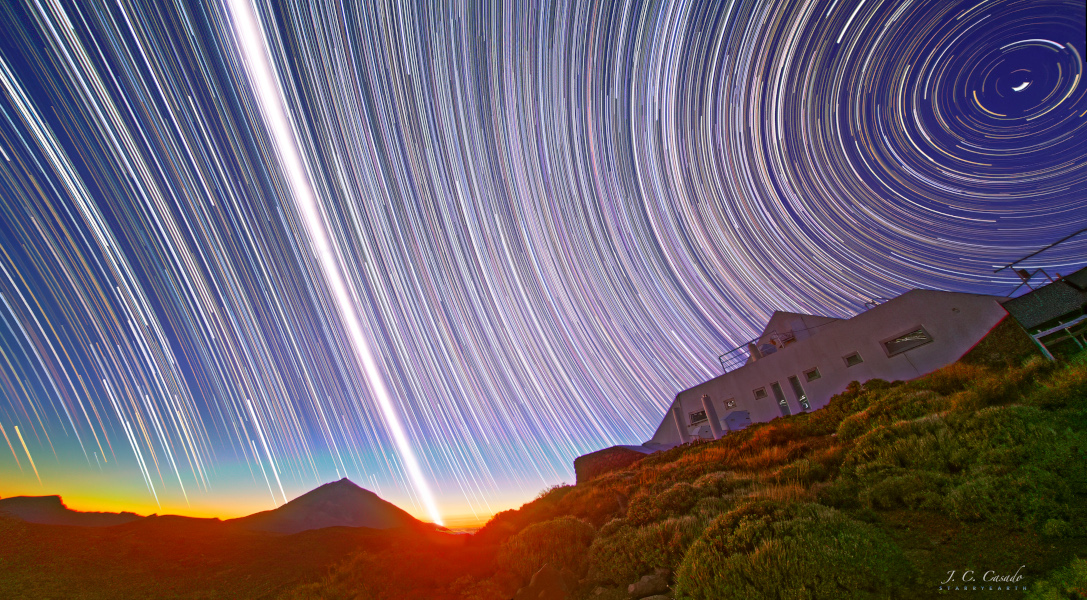
今天的春分是在格林尼治標準時間14:46(3月20日)。那是一個特別的時刻,當太陽穿過星空的赤道,朝北移動,標誌著北半球春天的開始,也意味著南半球的秋天。這時,全球的白天和夜晚大約是相等的。實際上,在西班牙的特內里費島,特德觀測台拍攝的春分的日間和夜間圖片通過合成組合在一起,讓我們見識到了美麗的星空畫面。為了這個精彩的春分計畫,共拍攝了超過1000張使用魚眼鏡頭拍攝的圖片,經過合併而成。在春分這一天,太陽在天空的運行路徑就像一條明亮的斜線,從白天的照片中展現出來,這個過程持續了6小時。在日落之後,夜晚的照片記錄了星星的軌跡,那條紅色的光帶是天上的赤道,而圓形的弧形則圍繞著北天極的北斗星,北斗星就在右上方,南天極則在左下方,超過了特德的地平線。前景中可以看到遙遠的特德火山峰和觀測台的金字塔形狀的太陽實驗室建築。
原文:
The defining astronomical moment of the equinox today is at 14:46 UTC (March 20). That’s when the Sun crosses the celestial equator moving north in its yearly journey through planet Earth’s sky, marking the beginning of spring for our fair planet in the northern hemisphere and fall in the southern hemisphere. Then, day and night are nearly equal around the globe. In fact, both day and nighttime exposures from a spring equinox at the Observatorio del Teide in Tenerife, Canary Islands, Spain, are used in this composited skyscape. Over 1,000 images were taken with a fisheye lens and merged in the ambitious equinox project. The apparent motion of the Sun setting along the celestial equator on the equinox date follows the bright linear, diagonal track from the sequence of daytime exposures taken over 6 hours. After sunset, nighttime exposures recorded startrails, with the celestial equator as a linear track and concentric arcs circling the north celestial pole near Polaris at upper right and the south celestial pole beyond the lower left edge (and below the Teide horizon). The foreground includes the distant Teide volcano peak and the observatory’s pyramid-shaped solar laboratory building.
來源:NASA每日圖片

