
Copyright:Peter Kennett
中文翻譯:
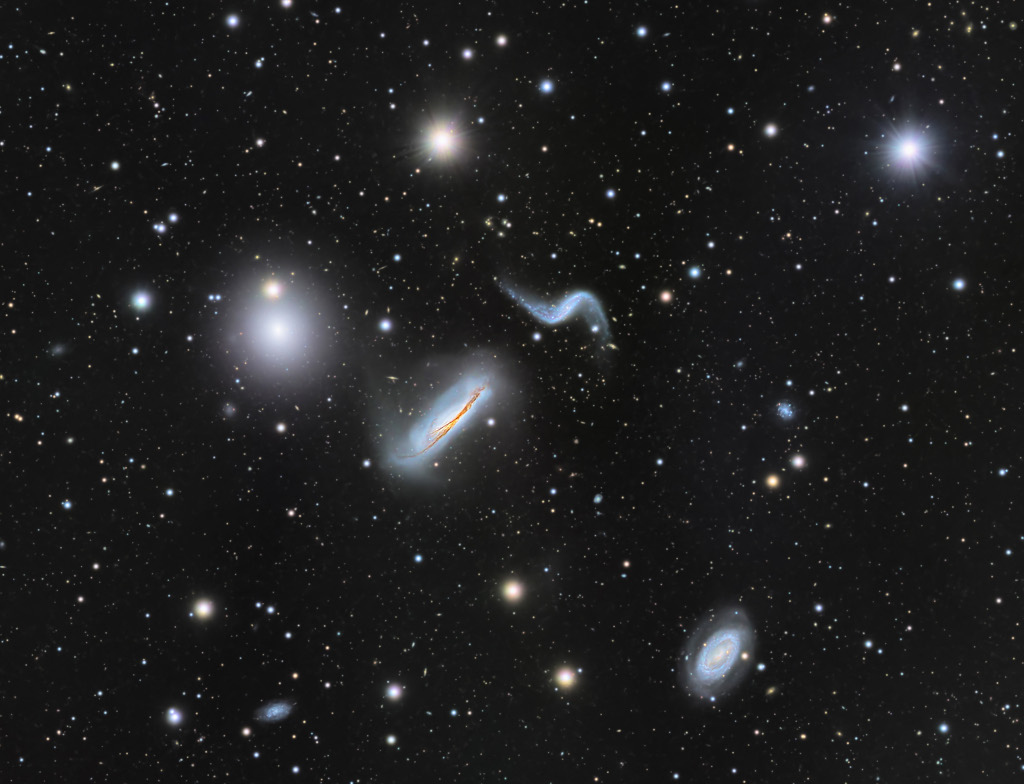
在遙遠的太空中,加拿大的天文學家保羅·希克森和他的同事們發現了約100個緊湊的星系群,這些星系群被叫做希克森緊湊星系。今天,我們來認識其中的一個星系群,叫做Hickson 44,距離地球約一億光年,位於北方春天的獅子座。這幅圖片中,中間的兩個螺旋星系是NGC 3190和NGC 3187,這兩個星系呈邊緣狀,非常獨特,NGC 3190有著扭曲的塵埃帶,NGC 3187則看起來像一個S形。左邊的明亮橢圓星系NGC 3193也叫做Arp 316。右下角的螺旋星系是Hickson 44的第四個成員NGC 3185。這些星系彼此之間有著力量的拉扯,這使得它們出現了變形和增強的恆星形成,預示著將來可能會發生星系合併的情況。星系合併是星系演化過程中的正常現象,甚至我們的銀河系也是如此。作為參考,NGC 3190的直徑約為75,000光年。
原文:
Scanning the skies for galaxies, Canadian astronomer Paul Hickson and colleagues identified some 100 compact groups of galaxies, now appropriately called Hickson Compact Groups. The four prominent galaxies seen in this intriguing telescopic skyscape are one such group, Hickson 44. The Hickson 44 galaxy group is about 100 million light-years distant, far beyond the foreground Milky Way stars, toward the northern springtime constellation Leo. The two spiral galaxies in the center of the image are edge-on NGC 3190 with distinctive, warped dust lanes, and S-shaped NGC 3187. Along with the bright elliptical, NGC 3193 (left) they are also known as Arp 316. The spiral toward the lower right corner is NGC 3185, the 4th member of the Hickson group. Like other galaxies in Hickson groups, these show signs of distortion and enhanced star formation, evidence of a gravitational tug of war that will eventually result in galaxy mergers on a cosmic timescale. The merger process is now understood to be a normal part of the evolution of galaxies, including our own Milky Way. For scale, NGC 3190 is about 75,000 light-years across at the estimated distance of Hickson 44.
來源:NASA每日圖片

