
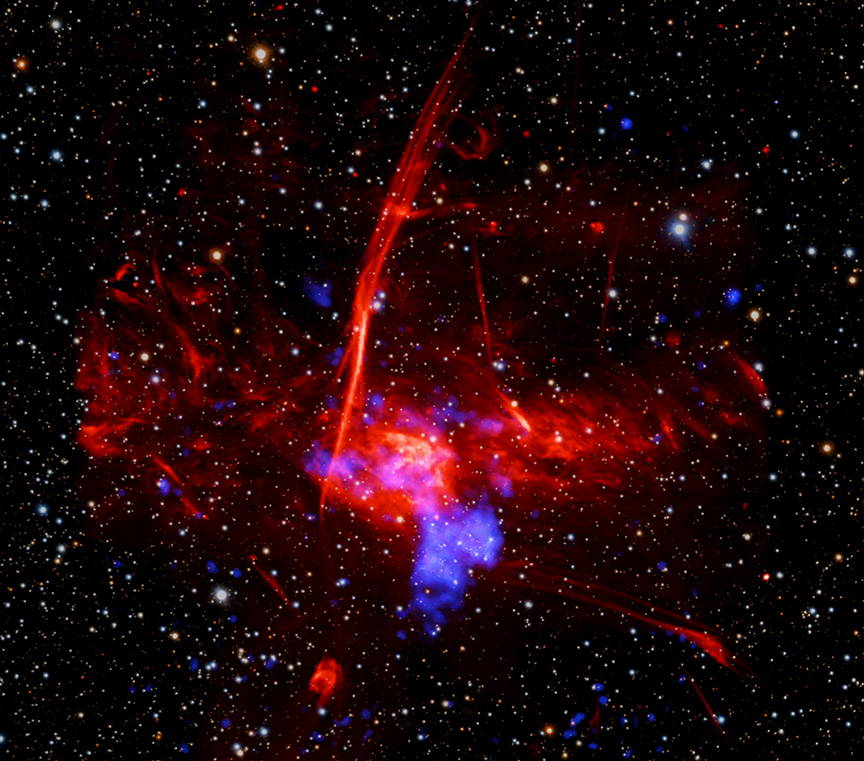
Copyright:X-ray: NASA/CXC/UCLA/Z. Zhu et al.; ESA/XMM-Newton; Optical: PanSTARRS; Radio: MeerKAT; Image Processing: NASA/CXC/SAO/L. Frattare and P. Edmonds
Text:
Cecilia Chirenti
(NASA
GSFC,
UMCP,
CRESST II)
中文翻譯:
你看到那個在圖片右下角的藍色小球嗎?天文學家認為那就是一顆巨大的星星爆炸成超新星後留下的痕跡,而它的光芒在1700年前到達了地球。這幅圖像結合了來自夏威夷的PanSTARRS望遠鏡所捕捉的光學數據(圖中的背景星星以紅色、綠色和藍色顯示),來自南非MeerKAT望遠鏡的無線電數據(大紅雲),以及來自美國NASA的Chandra X射線天文台和歐洲航天局的XMM-Newton的X射線數據(用藍色顯示)。那個大紅雲是名為Sagittarius C的恆星形成區,大約有50光年寬,距離地球約26000光年。它距離銀河系中心的超大質量黑洞只有約260光年(在圖片的左側)。如果這個藍色小球被確認是超新星的殘骸,那將是離銀河中心最近的發現之一。在這個密集的區域,巨星的死亡和新星的誕生透過氣體和磁場的複雜方式相互聯繫。
原文:
Do you see that blue blob to the lower right of the image center? Astronomers think that it shows where a massive star exploded as a supernova whose light reached Earth 1,700 years ago. The image combines optical data from the PanSTARRS telescopes in Hawaii (background stars in red, green, and blue), radio from the MeerKAT telescope in South Africa (large red cloud) and X-rays from NASA’s Chandra X-ray Observatory and ESA’s XMM-Newton (shown in blue). The large cloud is a star forming region called Sagittarius C, which is approximately 50 light-years in extent and about 26,000 light-years from Earth. It is located only about 260 light-years from the supermassive black hole in the center of the Galaxy (off to the left of the image). If the blue blob is confirmed to be a supernova remnant, it would be one of the closest ever discovered to the Galactic Center. In this dense region, the deaths of massive stars are connected to the birth of new stars through gas and magnetic fields in a complex way.
來源:NASA每日圖片
