
Copyright:Mazlin,
Parker, Forman, Magill,
Hanson
Text:
Keighley Rockcliffe
(NASA
GSFC,
UMBC CSST,
CRESST II)
中文翻譯:
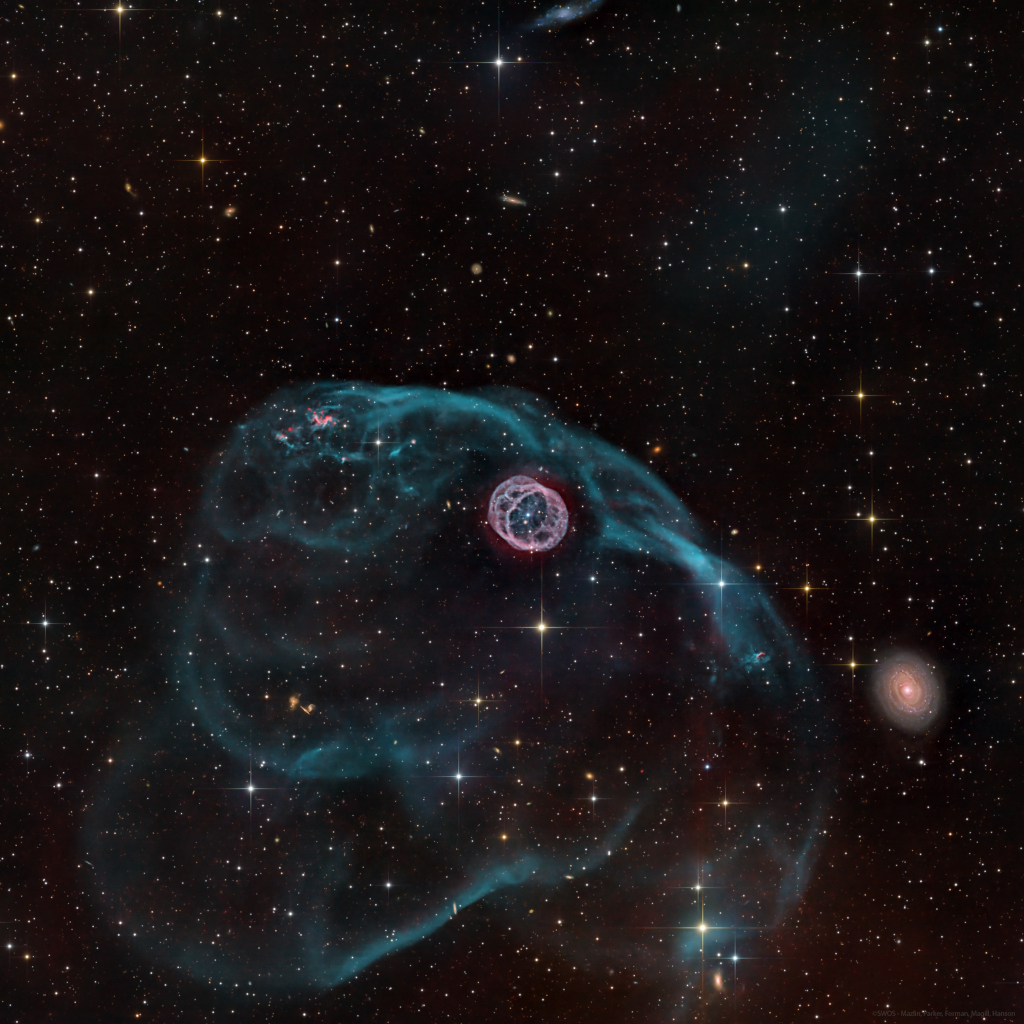
在遙遠的宇宙裡,有一個叫做Hamster Wheel Nebula(海姆斯特輪星雲)的神奇地方!這個星雲是由安德魯·朗摩(Andrew Longmore)在1976年發現的,當時他正在做一個探索南天的計劃。而這個計劃使用了新奇的攝影技術,例如更敏感的底片,讓他能夠捕捉到更深邃、更微弱的物體。這幅照片是在智利的El Sauce天文台拍攝的,顯示出一個發光的氫氣輪子,它是由一顆垂死的星星拋出來的,遺留的白矮星還對它進行了電離。這個結構在最初的圖片上幾乎是看不見的,這顯示了現代望遠鏡和相機的強大!兩個紅色氫氣團被藍色的電離氧氣包圍著,這暗示著在這個閃亮的白矮星旁邊可能還有一顆伴星!
原文:
How did a hamster wheel get into space? The Hamster Wheel Nebula (Longmore 8) was discovered by Andrew Longmore in 1976 as a part of a larger survey of the southern sky. This survey employed several improvements in photographic technology, including the use of highly sensitive film, to capture deeper and fainter objects on plates that were examined by eye and catalogued. The featured image, taken at Observatorio El Sauce in Chile, depicts an intricate wheel structure of glowing hydrogen that was thrown out into space by a dying star and ionized by the leftover white dwarf. This structure was barely visible on the original plate, emphasizing the power of modern telescopes and cameras. Two opposing clumps of red hydrogen gas encased in the blue veil of ionized oxygen hint at the presence of a companion to the bright white dwarf at the wheel’s center!
來源:NASA每日圖片

